

Shipping Cosmetics & Skincare to the UAE: Compliance, Storage & Transport Risks
NOVEMBER 27, 2025

Your construction crane sits motionless on Sheikh Zayed Road at two in the morning because nobody verified whether it would clear the pedestrian bridge overhead. The police escort you paid fifteen thousand dirhams for cannot help, the specialized transport company wants another twenty thousand dirhams to return and find an alternate route, and your construction project deadline slips another week while the equipment remains stranded between its origin and a destination just thirty kilometers away.
Moving heavy equipment and oversized cargo in UAE transforms from straightforward transportation into complex choreography involving multiple government authorities, specialized transport companies, structural engineers, police escorts, and precise timing windows that stretch simple moves into weeks-long operations costing ten to twenty times what normal freight would require. The challenges stem not from inefficiency or bureaucratic excess but from genuine physical and safety constraints that make moving massive, heavy, or tall cargo through modern urban infrastructure extraordinarily difficult without damaging roads, bridges, or overhead utilities while ensuring public safety throughout the movement.
Understanding this reality before you order heavy equipment or plan to move oversized cargo prevents the expensive surprises that catch unprepared businesses when they discover their forty-ton excavator cannot legally move during business hours, requires seven different government permits taking six weeks to obtain, needs four police escort vehicles costing thousands of dirhams, and must travel circuitous routes adding fifty kilometers to avoid bridges unable to support its weight. Let me guide you through this specialized logistics landscape systematically so you can plan intelligently rather than learning through painful experience.
Think about why governments establish limits defining what counts as oversized cargo requiring special handling. Roads, bridges, and tunnels get designed to accommodate vehicles up to certain dimensions and weights based on what normal commercial traffic requires. When cargo exceeds these design parameters, it creates risks that standard infrastructure was never engineered to handle. A bridge designed for vehicles weighing thirty tons maximum might fail structurally if a sixty-ton load crosses it. Power lines hanging four point eight meters above roads work fine for vehicles measuring four point five meters tall but get snagged by equipment reaching five point two meters.
UAE establishes specific thresholds where cargo transitions from standard freight to oversized requiring special permits and handling. The Roads and Transport Authority sets weight thresholds at thirty tons gross vehicle weight, meaning the combined mass of vehicle and cargo cannot exceed thirty thousand kilograms without special authorization. Width limits sit at three point five meters, beyond which cargo extends into adjacent traffic lanes creating collision hazards. Height restrictions vary by route but generally trigger at four point five meters where overhead infrastructure like pedestrian bridges, traffic signals, and power lines might create clearance conflicts. Length exceeds normal at twenty meters where vehicle maneuverability through intersections and roundabouts becomes problematic.
Here comes a critical insight that many people miss when planning heavy equipment purchases. These thresholds are not arbitrary numbers but represent actual physical constraints where exceeding limits by even small amounts creates disproportionate complications. Equipment measuring three point four nine meters wide ships as standard freight with minimal special requirements. The identical equipment measuring three point five one meters suddenly requires special permits, route surveys, police escorts, and time-of-day restrictions because that extra two centimeters pushes it into the adjacent lane where it creates safety hazards requiring traffic control. The cost difference between three point four nine and three point five one meters can easily reach fifty thousand dirhams in additional logistics expenses, making dimensional specifications absolutely critical considerations when purchasing equipment rather than minor technical details you ignore.
The weight classification system operates similarly, with each threshold triggering progressively more stringent requirements. Cargo between thirty and fifty tons requires enhanced structural assessments and potentially bridge-by-bridge weight verification along the entire route. Equipment exceeding fifty tons enters a category requiring detailed engineering analysis of every road segment and bridge, often necessitating temporary structural reinforcement or complete avoidance of infrastructure unable to support such loads. The heaviest categories above one hundred tons may require road closures, police escorts spanning the entire movement, and engineering teams accompanying the transport to monitor structural responses in real-time. Understanding where your specific cargo falls within these classification tiers helps you anticipate the complexity and cost you will face rather than discovering requirements only after committing to equipment purchases that trigger regulatory categories you never anticipated encountering.
Moving oversized cargo legally requires obtaining approvals from multiple independent government authorities who each control different aspects of road infrastructure and public safety. Understanding why multiple permits exist helps you appreciate that this complexity serves genuine coordination needs rather than representing bureaucratic redundancy. The Roads and Transport Authority manages road surfaces and structural integrity, ensuring your cargo will not damage pavement or exceed bridge weight ratings. Dubai Police controls traffic flow and public safety, determining when and how oversized moves can occur without creating unacceptable collision risks. Individual municipalities govern local infrastructure like streetlights and landscaping that cargo might impact. Electric and water utilities must approve routes where overhead power lines or underground utilities might conflict with your cargo dimensions.
Each authority maintains independent application processes with different documentation requirements, approval timelines, and fee structures. You cannot simply apply to one central office that coordinates everything automatically. Instead, you must engage with each authority separately, often requiring their approvals in specific sequences where later authorities will not even accept applications until earlier approvals are secured. The Roads and Transport Authority typically must approve first since their structural assessment determines whether movement is physically possible at all. Police permits follow once route feasibility is established. Municipal and utility approvals come last after the basic movement plan is finalized.
Consider what happened when a manufacturing facility needed to move a large backup generator weighing fifty-five tons from Jebel Ali port to their factory in Dubai Industrial City. The transport company needed approval from Roads and Transport Authority for route structural adequacy, Dubai Police for traffic escort coordination, Dubai Municipality for temporary removal of streetlight poles that would obstruct passage, DEWA for raising power lines at three intersection crossings, Jebel Ali Free Zone Authority for exit from port facilities, Dubai Industrial City for entry to the destination facility, and Civil Defense for confirming the generator transport did not create fire access blockages.
Obtaining these seven permits consumed five weeks despite using experienced logistics specialists who knew the processes intimately. The permit fees alone totaled forty-eight thousand dirhams before any actual transport occurred. Several permits required structural engineering reports costing an additional twelve thousand dirhams. When one permit got delayed because the responsible official was on vacation and nobody else had signature authority, the entire project schedule slipped by ten days because subsequent permits could not be obtained until that critical approval arrived. This cascading delay pattern demonstrates why experienced shippers build six to eight week lead times for oversized moves rather than assuming permits arrive quickly like routine shipping documents.
The cost of permits varies dramatically based on cargo characteristics and route complexity. Simple moves involving equipment just slightly exceeding standard dimensions on straightforward routes might require fifteen to twenty thousand dirhams in permits and associated engineering documentation. Complex moves involving very heavy or tall cargo requiring route modifications like temporary power line raising, traffic signal relocation, or bridge reinforcement can exceed one hundred thousand dirhams in permit costs alone. Understanding that permits represent a major cost component comparable to the actual transportation charges helps you budget realistically rather than assuming permits are minor administrative fees adding negligible expense to your heavy equipment logistics.
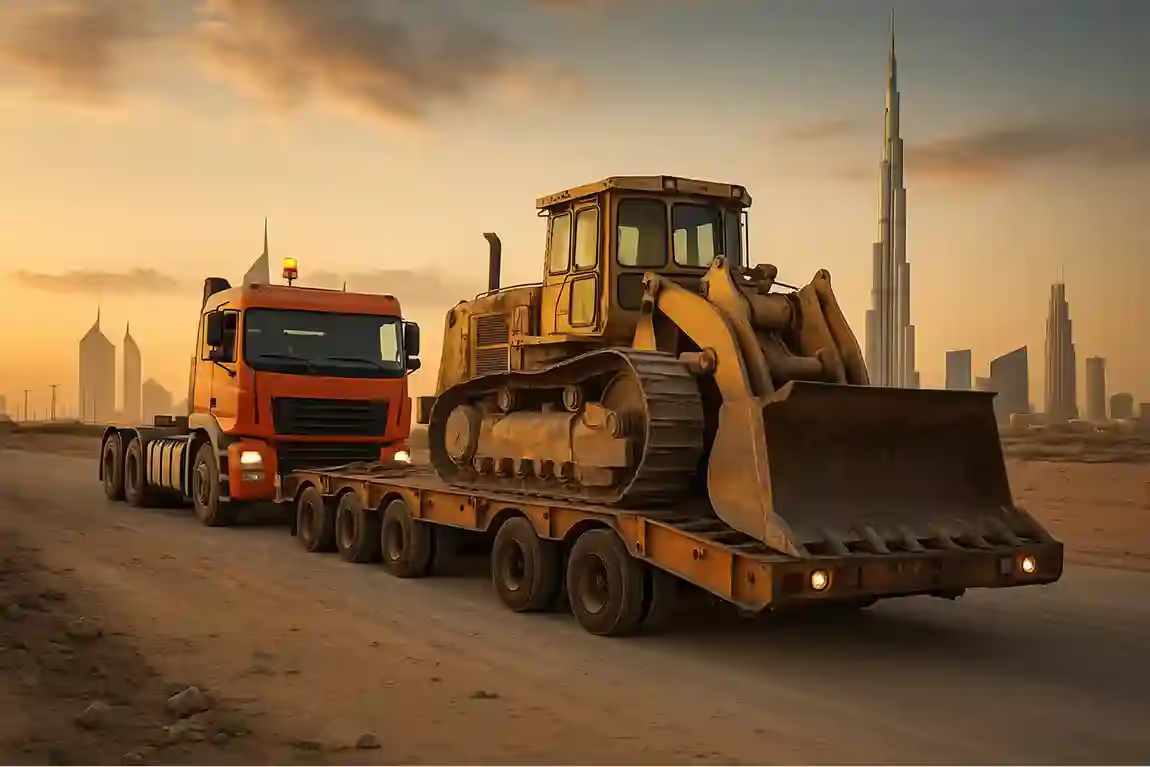
Think about how standard GPS navigation works for normal vehicles. The system knows road locations and calculates the shortest or fastest route between your origin and destination based on speed limits and traffic patterns. This approach fails catastrophically for oversized cargo because GPS databases contain no information about bridge weight limits, overhead clearances, roundabout turning radiuses, or road surface strength that determine whether your heavy equipment can physically traverse a particular route. A path showing as the optimal route for standard vehicles might prove completely impassable for your forty-ton crane requiring four point seven meter clearance through every overhead obstacle.
Bridge weight restrictions create invisible barriers that require manual verification for every bridge along potential routes. UAE maintains thousands of road bridges and overpasses designed for different load capacities based on when they were built and what traffic volumes they needed to accommodate. Older bridges in established neighborhoods might support only twenty-five tons, while newer highway infrastructure handles forty tons or more. No public database lists every bridge's weight rating in GPS-compatible format, meaning route planning requires physically surveying the intended path and verifying weight capacity for every bridge the cargo must cross. Missing even one underrated bridge forces complete route reworking after permits are already obtained, restarting the entire approval process.
Overhead clearance conflicts prove equally problematic because UAE's urban density creates countless overhead obstacles that would never concern normal vehicles. Pedestrian bridges crossing major roads typically provide five point two to five point five meter clearance adequate for all standard vehicles but insufficient for equipment exceeding five meters. Power lines, traffic signal gantries, and decorative archways create additional overhead hazards that standard GPS cannot identify. Route surveys must physically measure clearance at every potential conflict point, often discovering that what looked like a straightforward route contains impassable obstacles requiring detours that add significant distance and complexity.
Roundabouts present particularly vicious challenges because UAE favors roundabout intersections for traffic flow management, but these circular designs prove nearly impossible for extra-long cargo to navigate. Imagine trying to steer a twenty-five meter long trailer through a tight circular path designed for twelve meter vehicles. The turning radius physically cannot be achieved without either mounting curbs, which damages roads and risks cargo stability, or implementing temporary traffic diversions where other vehicles get blocked while your cargo makes a multi-point turn occupying all lanes simultaneously. Some roundabouts simply cannot accommodate certain cargo sizes at any cost, creating absolute barriers that force routes to avoid entire neighborhoods regardless of how direct they would otherwise be.
The International Road Transport Union provides guidance on international standards for vehicle dimensions and routing considerations, though UAE-specific infrastructure requires local expertise that international frameworks cannot substitute adequately. Understanding these physical constraints helps you appreciate why experienced heavy hauling companies invest heavily in route survey capabilities and maintain detailed databases about local infrastructure limitations that standard mapping services completely ignore.
UAE restricts oversized cargo movement to specific time windows when traffic volumes stay low enough that the disruption from slow-moving wide loads can be managed without creating unacceptable congestion. These restrictions typically confine movement to midnight through dawn periods, often specifically from one AM to five AM when traffic reaches daily minimums. Think about why these tight windows exist rather than viewing them as arbitrary obstacles. An oversized load traveling at twenty kilometers per hour while occupying two full lanes creates massive traffic backups during rush hour when thousands of commuters need those lanes. The same movement during the dead of night passes with minimal impact because so few vehicles are on the road that the temporary lane occupation causes negligible disruption.
These narrow time windows create planning nightmares because your cargo must reach its destination within the four-hour movement period or face twenty-four hour delays waiting for the next approved window. A move that encounters unexpected obstacles like the crane clearance conflict from our opening scenario cannot simply continue during daylight hours to complete the delivery. Instead, the cargo must pull over and wait twenty hours for the next movement window, accruing storage charges and police escort fees for the additional attempt while your project timeline slips another full day. The pressure to complete moves within tight windows explains why experienced transport companies invest heavily in route surveys and contingency planning rather than optimistically assuming everything will proceed smoothly on the first attempt.
Police escort requirements add significant cost and coordination complexity because authorities mandate dedicated police presence for public safety during oversized cargo movements. The number of escort vehicles depends on cargo dimensions and route characteristics, ranging from two vehicles for moderately oversized cargo on simple routes to four or more vehicles for extremely large or heavy cargo on complex urban routes. Each escort vehicle costs two to four thousand dirhams per movement attempt, meaning a move requiring four escorts might incur sixteen thousand dirhams in police costs alone before any transportation charges. These escorts cannot be scheduled casually but require advance booking through official channels that often impose their own lead time requirements independent of permit timelines, creating another coordination dependency that extends planning horizons.
For movements crossing emirate boundaries, coordination becomes even more complex because each emirate maintains its own police force with independent escort arrangements. A shipment from Dubai to Abu Dhabi requires coordinating with both Dubai Police and Abu Dhabi Police, with handoff points along the route where escort responsibility transfers between jurisdictions. These inter-emirate movements require additional planning lead time and may face scheduling constraints when one emirate's escort availability does not align with another's approved windows.
Successfully navigating all permits, route challenges, and timing restrictions gets your heavy equipment to the destination vicinity, but actually positioning it at its final operational location often proves more difficult than the entire preceding journey. Think about what happens when a forty-ton excavator arrives at a construction site but must be unloaded and moved to its working position fifty meters inside the site. Standard construction equipment cannot simply drive off the transport trailer because specialized hydraulic ramps or heavy lift cranes are required to safely transfer multi-ton cargo from transport height to ground level without destroying the cargo, the trailer, or surrounding infrastructure.
Mobile crane rentals for heavy equipment unloading typically cost five thousand to fifteen thousand dirhams depending on crane capacity requirements and duration needed. A forty-ton excavator might require a sixty-ton capacity crane accounting for lifting geometry and safety factors, keeping the crane on site for three to four hours while rigging, lifting, positioning, and securing the equipment properly. These crane costs often surprise businesses who never considered that their equipment purchase price included only the equipment itself without any provision for the specialized handling required to actually get it operational at their site. The crane company cannot simply appear on demand but requires advance scheduling that might extend several days or weeks during busy construction periods, meaning your equipment sits on a transport trailer accumulating storage charges while waiting for crane availability.
Site access limitations in dense urban environments create situations where equipment physically arrives at the correct address but cannot reach its intended location because the final meters prove impassable. Imagine ordering a large generator for a building under construction in downtown Dubai. The transport trailer reaches the street address successfully after navigating all the oversized cargo challenges we discussed. However, the building site entrance involves a narrow access lane that the trailer cannot enter, and the generator must somehow travel another thirty meters from the street to the designated equipment room. The crane that could lift it from the trailer cannot position itself to also place it in the final location due to overhead obstructions or inadequate ground space for stabilizer deployment. You now face an expensive puzzle requiring additional equipment or temporary structure installation just to bridge this final gap that seemed trivial when planning from satellite imagery but proves insurmountable in physical reality.
Ground bearing capacity represents another frequently overlooked constraint that creates last-meter problems even when access routes appear adequate. Heavy lift cranes require deploying stabilizer legs that concentrate enormous point loads onto relatively small ground contact areas. Soft soil, underground utilities, or basement structures beneath the surface may not support these concentrated loads, risking ground collapse or infrastructure damage that liability would make the shipper responsible for covering. Professional site assessments should verify ground conditions before committing to crane positioning plans, but businesses rushing to receive equipment often skip this step and discover problems only when the crane arrives and its operator refuses to deploy in locations where ground failure seems likely.
Understanding complete oversized cargo costs requires abandoning any assumption that transportation quotes represent total expenses. Let me walk you through a real cost breakdown to demonstrate how charges accumulate far beyond initial transport quotations. Consider moving a forty-five ton excavator from Jebel Ali port to a construction site in Dubai Marina, a distance of approximately fifty kilometers that normal freight would cover for perhaps two thousand dirhams. Your initial transport quote from a specialized heavy hauling company comes in at eighteen thousand dirhams, which already feels expensive but includes the specialized trailer and tractor unit required for the weight.
However, that eighteen thousand dirham quote explicitly excludes permits, escorts, route modifications, and lifting services. Permit costs add thirty-five thousand dirhams covering Roads and Transport Authority approval, police movement permits, municipality permissions, and required structural engineering assessments. Police escort requirements for four vehicles total fourteen thousand dirhams. The move requires temporary raising of two traffic signal gantries that would otherwise obstruct the excavator height, costing eight thousand dirhams in utility coordination fees. Port discharge requires a specialized heavy lift crane costing twelve thousand dirhams. Final positioning at the construction site needs another crane rental at nine thousand dirhams. Insurance covering the high-value cargo during specialized transport adds six thousand dirhams.
The complete cost breakdown includes the following major components:
Totaling these components reveals actual costs of one hundred two thousand dirhams for the complete door-to-door movement, representing five hundred sixty-seven percent of the base transport quote and fifty-one times what normal freight would cost for the identical distance. This dramatic cost multiplication shocks businesses who naively assumed their shipping budget should roughly match container freight charges they pay for standard cargo. Understanding these realities before committing to heavy equipment purchases allows you to factor true logistics costs into your procurement decisions rather than discovering too late that moving the equipment costs nearly as much as purchasing it did.
When your heavy equipment originates internationally, additional complications emerge at UAE ports where specialized discharge capabilities determine whether your cargo can even enter the country physically. Standard container handling equipment at ports manages loads up to thirty tons using regular container cranes. Equipment exceeding these limits requires specialized heavy lift cranes with capacities reaching several hundred tons, and these cranes exist at only certain port facilities with limited availability requiring advance booking. A shipment arriving without confirming heavy lift crane availability might sit on the vessel for days or weeks waiting for the specialized equipment needed to discharge it, accruing demurrage charges from the shipping line that can reach thousands of dollars daily.
The International Maritime Organization establishes standards for cargo handling and vessel operations that affect how heavy equipment gets loaded and discharged internationally. Understanding these standards helps you work with shipping lines and port operators to ensure your cargo receives appropriate handling throughout its international journey rather than discovering at discharge that the receiving port lacks necessary equipment or expertise.
Customs clearance for heavy equipment involves additional scrutiny compared to standard commercial cargo because authorities want to verify that proper import documentation exists, applicable duties and taxes get paid correctly, and the equipment complies with UAE safety and environmental standards. Dubai Customs processes these specialized imports through dedicated channels that handle technical goods requiring specialized assessment. Construction equipment particularly faces inspection to ensure it meets emission standards that prevent excessively polluting machinery from operating within UAE. Medical or scientific equipment might require regulatory approvals from health authorities before customs releases it. These specialized clearance requirements extend processing timelines and may demand technical documentation that your overseas supplier never provided, creating clearance delays that extend port storage charges while you scramble to obtain required paperwork from manufacturers who may not prioritize your urgent requests.
The International Federation of Freight Forwarders Associations provides resources on documentation standards and best practices for international cargo movements that can help you understand what paperwork your shipments require before they depart origin countries. Engaging freight forwarders who hold FIATA certifications often indicates professional competence in managing complex international shipments including heavy equipment moves requiring specialized handling throughout the logistics chain.
Success with oversized cargo requires involving specialized logistics experts from your project's earliest planning stages rather than treating transportation as a late-stage procurement detail you address after ordering equipment. Experienced heavy hauling companies can survey your destination site during the planning phase and identify access constraints that should influence which equipment models you purchase based on their dimensions matching what your site can actually accommodate. They can provide realistic cost estimates including all the hidden components we discussed so your project budget reflects actual expenses rather than naive underestimates that cause budget overruns when reality emerges.
Lead time requirements for oversized moves typically span four to eight weeks minimum from when you first engage the logistics company to when cargo actually moves. This timeline accommodates permit applications across multiple authorities, route surveys and structural assessments, police escort scheduling, crane booking, and the inevitable delays that occur when one approval takes longer than expected or requires additional information before proceeding. Trying to compress these timelines through urgent requests rarely succeeds because the regulatory and physical constraints cannot be circumvented through willingness to pay premium rates or exert political pressure. Understanding that oversized logistics operates on fundamentally different timescales than normal freight prevents the frustration of expecting rapid movement when the system simply cannot accommodate haste regardless of your urgency.
When evaluating equipment purchases that might involve oversized cargo challenges, ask your logistics consultant these critical questions before committing to specific models:
These questions help you make informed decisions about whether specific equipment models justify their logistics complexity or whether alternative models with better dimension profiles would serve your needs while drastically reducing transportation challenges. Sometimes paying slightly more for equipment designed with transport considerations delivers net savings by avoiding the massive oversized cargo premiums that cheaper but larger alternatives would trigger. This total cost of ownership thinking that incorporates logistics rather than focusing narrowly on purchase price represents the sophisticated approach that successful heavy equipment operators adopt after learning through experience how dramatically transportation can impact project economics.
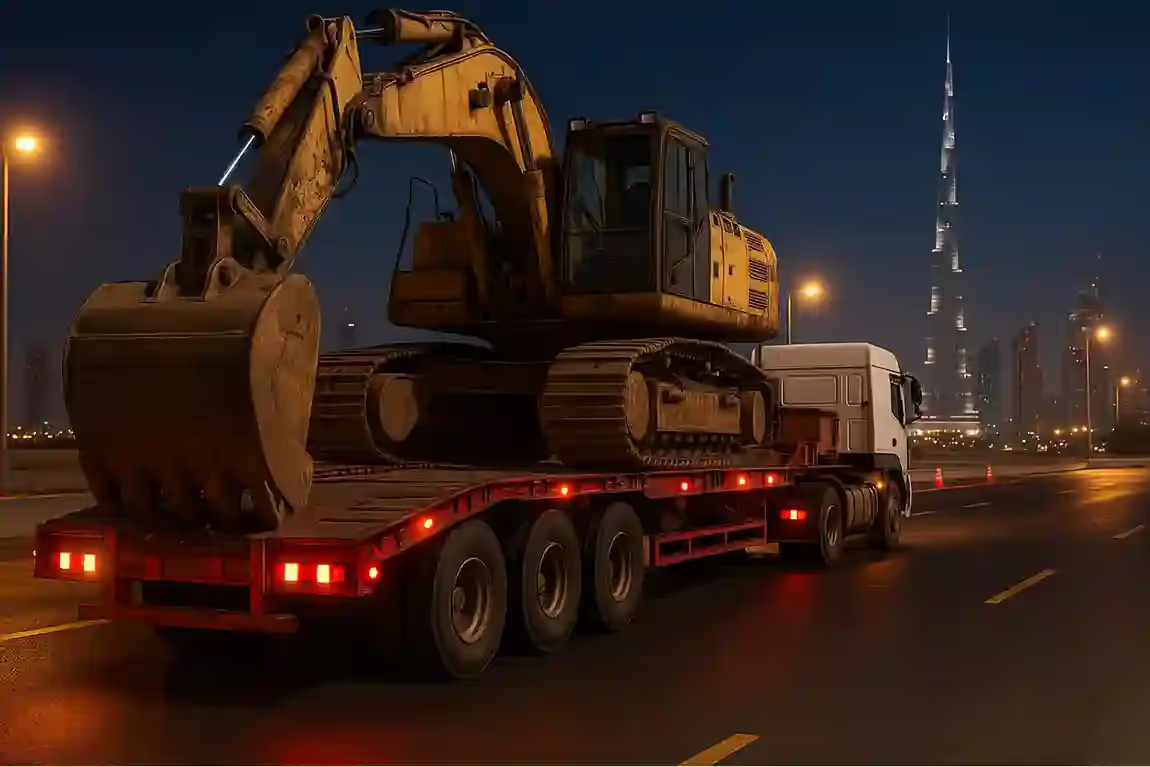
Selecting the right heavy hauling company proves crucial because capabilities vary enormously across providers who all claim expertise in oversized cargo but who actually possess vastly different equipment inventories, regulatory relationships, route knowledge, and operational experience. The cheapest quote often comes from companies lacking the specialized trailers, experienced operators, or permit expertise required for smooth movements, meaning their low prices reflect corners they cut that will create problems during actual execution.
Evaluate potential transport providers by investigating their specific equipment capabilities, asking to see trailers they would use for your cargo rather than accepting claims about equipment they theoretically could rent if needed. Verify their permit track record by asking for references from recent similar moves where you can confirm that permits were obtained within promised timeframes without unexpected complications. Assess their route planning sophistication by asking how they survey routes and what databases they maintain about local infrastructure limitations that might affect your movement.
The best providers maintain long-standing relationships with regulatory authorities that expedite permit processing through established trust and proven compliance records. They employ dedicated permit specialists who understand exactly what documentation each authority requires and how to present applications in formats that minimize requests for additional information or clarification that delay approvals. They operate their own crane fleets or maintain priority relationships with crane providers ensuring equipment availability when their transport schedules require it rather than depending on spot market crane rentals that may prove unavailable during busy periods.
Companies affiliated with international logistics networks often bring additional capabilities for handling heavy equipment imports that originate overseas. Their global relationships help coordinate international shipping with domestic final delivery, ensuring that vessel discharge plans align with inland transport permits and that the complete movement proceeds seamlessly rather than encountering handoff problems where international and domestic logistics fail to synchronize properly.
Proper documentation protects your interests throughout oversized cargo movements by establishing clear records of cargo condition at each transfer point, defining responsibility allocation when problems occur, and providing the evidence necessary to pursue insurance claims if damage happens despite everyone's best efforts. Think about documentation as investment in problem resolution rather than bureaucratic burden, because the few hours spent creating proper records can save months of dispute resolution and potentially hundreds of thousands of dirhams in unrecoverable losses when problems occur.
Pre-shipment condition surveys conducted by independent inspectors establish baseline documentation showing your equipment's exact condition before transport begins. These surveys include detailed photographs, measurements, and written descriptions of any existing wear, damage, or notable characteristics that might otherwise be blamed on the transport process when the equipment arrives. Without baseline documentation, transport companies can plausibly claim that scratches, dents, or functional problems existed before they took custody, leaving you unable to prove otherwise and therefore unable to recover damages that occurred during their handling.
Insurance for heavy equipment transport requires specialized policies that standard cargo insurance does not provide. Regular marine cargo policies often exclude machinery above certain values or impose conditions that oversized cargo movements cannot satisfy, such as requirements for containerized shipment that obviously cannot apply to equipment too large for containers. Work with insurance brokers experienced in project cargo and heavy lift coverage who understand the specific risks these movements entail and can structure policies providing meaningful protection rather than policies that look adequate until you try to file a claim and discover exclusions that eliminate coverage for exactly the situations most likely to cause losses.
The UAE Insurance Authority regulates insurance providers operating in UAE and can help verify that insurers offering coverage possess proper authorization and financial strength to actually pay claims when they arise. Checking insurer credentials before purchasing policies prevents the devastating discovery that your insurance provider lacks ability or willingness to honor claims when you most need protection.
The oversized cargo challenges we explored stem from genuine physical and safety constraints rather than arbitrary bureaucratic obstacles designed to frustrate businesses. Roads and bridges have weight limits because exceeding them causes structural damage or collapse. Movement timing restrictions exist because daytime oversized transport would create unacceptable traffic disruption affecting thousands of commuters. Permit requirements coordinate multiple authorities who each control infrastructure elements that your cargo might impact. Understanding these underlying reasons helps you approach oversized logistics with appropriate respect for the complexity rather than naive assumptions that things should be simpler than they actually are.
The difference between nightmare experiences and successful heavy equipment moves comes down to planning quality and timeline realism. Businesses that engage specialists early, budget for complete costs rather than just transport quotes, and build eight-week lead times into their schedules experience smooth movements despite all the complexity we discussed. Those who assume oversized cargo works like normal freight discover through painful experience that wishful thinking cannot overcome physical realities or compress regulatory timelines through urgency alone.
The UAE Ministry of Economy and various emirate-level authorities continue developing infrastructure and regulatory frameworks that affect heavy equipment logistics. Staying informed about regulatory changes and infrastructure improvements helps you anticipate how oversized cargo handling may evolve over time, potentially creating new opportunities or requirements that affect your future equipment decisions.
Your heavy equipment logistics will involve complexity regardless of your preferences, but whether that complexity manifests as manageable process or expensive chaos depends entirely on how seriously you take planning before making commitments that cannot be reversed once equipment is ordered or already en route to destinations that may prove inaccessible without preparation you neglected to complete in advance. The investment in proper planning, realistic budgeting, and adequate timeline allocation pays returns many times over compared to the expensive lessons that unprepared businesses learn through stranded equipment, blown budgets, and missed project deadlines that proper preparation would have prevented entirely.
Disclaimer: This article provides general educational information about typical challenges and costs associated with oversized cargo shipping in UAE based on common scenarios. Actual requirements, costs, timelines, and procedures vary significantly based on specific cargo characteristics, origin and destination locations, current permit backlogs, equipment availability, regulatory changes, and countless other factors that individual circumstances cannot anticipate through general guidance. The cost figures and timeline estimates represent approximate ranges from typical cases rather than guaranteed predictions for your specific situation. Always obtain detailed quotes from multiple specialized heavy hauling companies, verify current permit requirements directly with relevant authorities, conduct physical route surveys before committing to equipment purchases, and build substantial contingency into both budgets and schedules to accommodate the inevitable complications that arise even with excellent planning. This content does not constitute professional logistics consulting or engineering advice. Consult qualified specialists for guidance specific to your heavy equipment transportation needs.
NOVEMBER 27, 2025
NOVEMBER 26, 2025
NOVEMBER 26, 2025
NOVEMBER 26, 2025
NOVEMBER 26, 2025