

Shipping Cosmetics & Skincare to the UAE: Compliance, Storage & Transport Risks
NOVEMBER 27, 2025
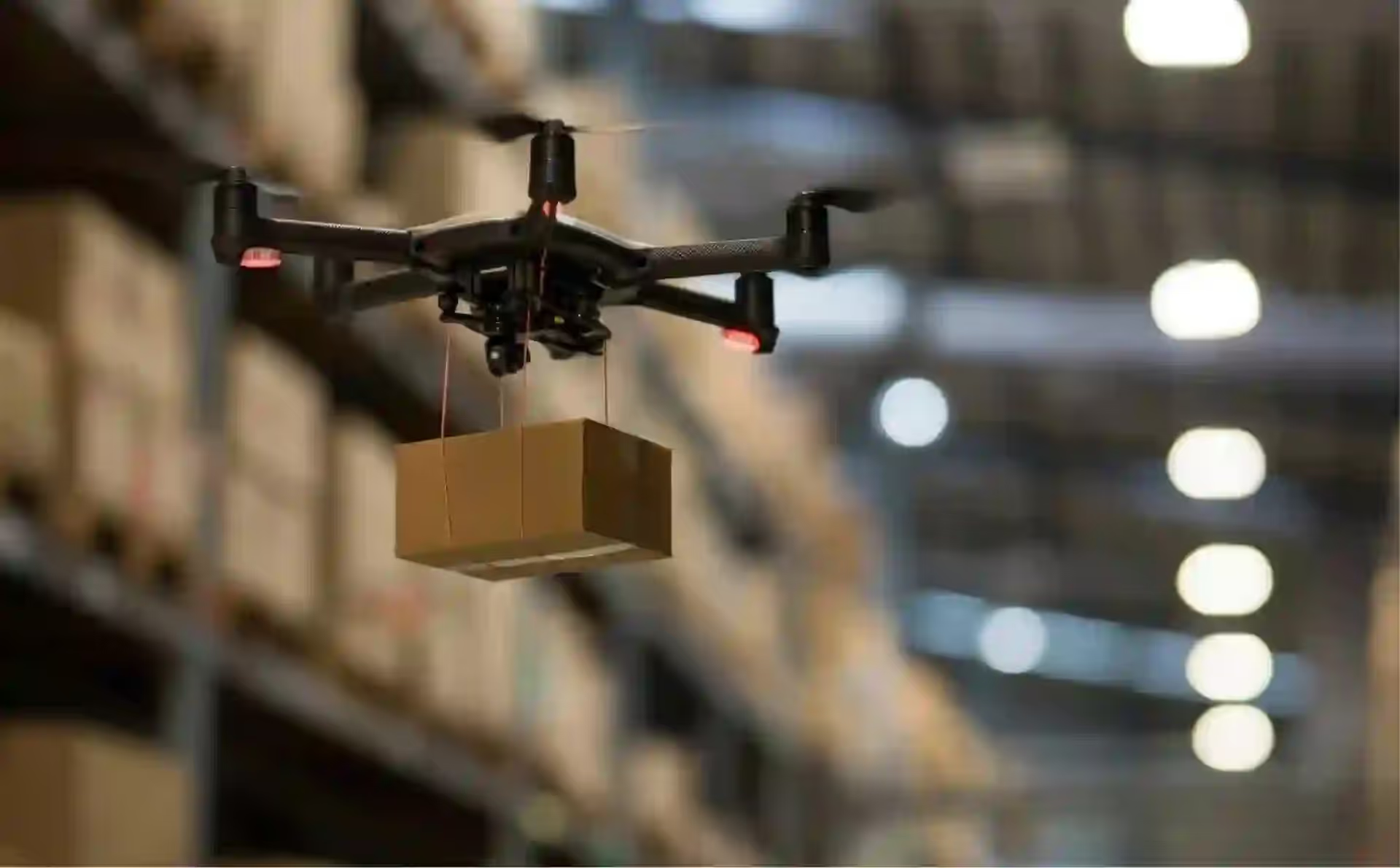
Shipping a pallet of consumer goods to the UAE is relatively straightforward. Shipping a drone with advanced imaging capabilities? That's a different story entirely.
The United Arab Emirates has positioned itself as a global magnet for advanced technology. Smart city initiatives like NEOM collaboration projects, ambitious aerospace programs, defense modernization efforts, research clusters in Dubai and Abu Dhabi, and massive industrial innovation zones have created explosive demand for cutting-edge hardware. American manufacturers of 3D printers, drone systems, robotics, sensors, and specialized electronics see the UAE as a natural growth market—and they're right.
But here's what catches many U.S. exporters off guard: getting high-tech equipment legally into the UAE involves navigating two overlapping regulatory frameworks, not one. On the American side, export controls administered by multiple federal agencies determine what you can ship, to whom, and under what conditions. On the UAE side, customs authorities, civil aviation regulators, and security bodies have their own requirements for what enters the country and how it can be used once it arrives.
Miss something on either side and your shipment sits in a warehouse indefinitely. Get it wrong badly enough and you're facing federal enforcement action, seizure of goods, or permanent exclusion from a lucrative market.
This isn't meant to scare you away from the opportunity. The UAE genuinely wants this technology—they're building the infrastructure to support it. But they want it through proper channels, with proper documentation, and with proper end-user clarity. So does the U.S. government.
This article walks you through both sides of that equation: U.S. export control requirements and UAE import and operational rules. By the end, you'll have a practical playbook for moving 3D printers, drones, sensors, and other high-tech equipment from your U.S. facility to a UAE customer without tripping regulatory wires on either continent.
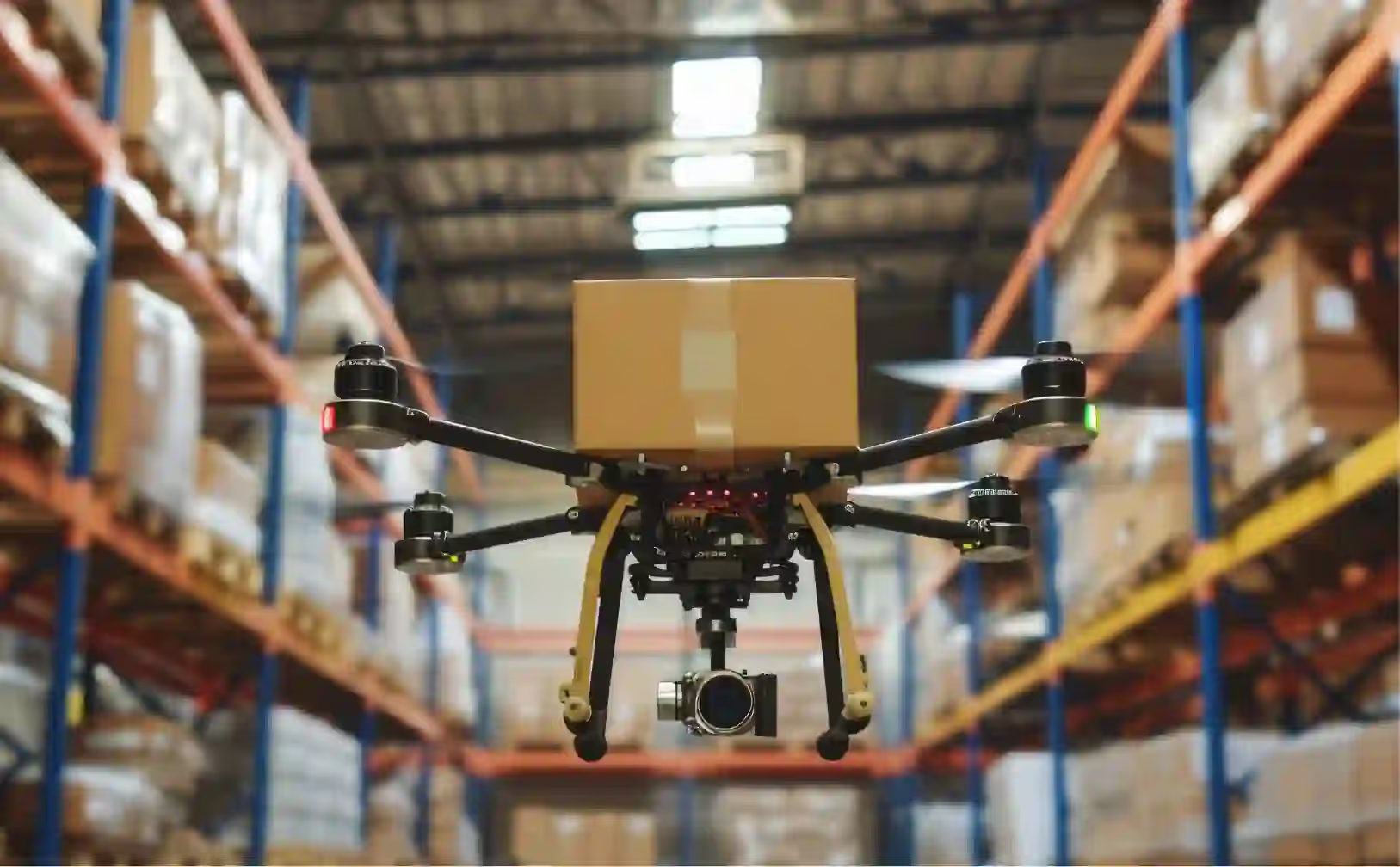
Before your equipment leaves American soil, you need to know whether it can leave at all—and if so, under what conditions. The U.S. maintains one of the world's most sophisticated export control regimes, and high-tech equipment sits squarely in its crosshairs.
The Export Administration Regulations, known as EAR, form the backbone of U.S. export controls for commercial and dual-use goods. Administered by the Bureau of Industry and Security (BIS) within the Department of Commerce, the EAR covers an enormous range of products—from sophisticated industrial machinery to certain software and technology. The BIS introduction to export controls provides the official overview of this framework.
For manufacturers and exporters of 3D printers, drones, sensors, advanced electronics, and similar equipment, EAR compliance isn't optional. The regulations capture not just obviously sensitive items but also many products that seem routine until you understand their dual-use potential. A 3D printer that produces plastic prototypes? Probably fine. A metal additive manufacturing system capable of producing aerospace components with specific tolerances? That's a different classification entirely.
The key concept under EAR is control status. Every item subject to EAR falls into one of two categories: it either has a specific Export Control Classification Number (ECCN) placing it on the Commerce Control List, or it's classified as EAR99, meaning it's subject to EAR jurisdiction but not specifically controlled. EAR99 items generally don't require export licenses except in specific circumstances involving problematic end users, end uses, or destinations.
The Commerce Control List is where classification gets specific. This document organizes controlled items into ten categories, each with subcategories defining particular types of equipment, materials, software, or technology. ECCNs follow a structured format—the first digit indicates the category, the second indicates the product group within that category, and additional characters provide further specificity.
For high-tech equipment heading to the UAE, certain ECCNs appear frequently. Drones and unmanned aerial systems often fall under Category 9 (Aerospace and Propulsion), though components may appear elsewhere. 3D printers capable of producing controlled materials or achieving controlled specifications may appear in Category 2 (Materials Processing). Sensors, imaging equipment, and electronics scatter across multiple categories depending on their capabilities.
Finding your product's ECCN requires careful technical analysis. The list doesn't organize itself by product name—you won't find a heading labeled "drones" or "3D printers." Instead, you match your product's technical parameters against the specifications in each potentially applicable ECCN. If your product meets or exceeds the control thresholds, that ECCN applies.
Some technology never touches the Commerce Control List because it's controlled under an entirely different regime. The International Traffic in Arms Regulations (ITAR), administered by the State Department's Directorate of Defense Trade Controls (DDTC), governs defense articles and services. The DDTC's ITAR portal provides official guidance on these controls.
For drone manufacturers particularly, the ITAR line matters enormously. Military-grade unmanned aerial systems, certain advanced imaging and surveillance systems, and components specifically designed for defense applications often fall under ITAR rather than EAR. The consequences of misclassification are severe—ITAR violations carry criminal penalties and can shut down your export operations entirely.
How do you know if your product is ITAR-controlled? The U.S. Munitions List (USML) defines categories of defense articles subject to ITAR. If your product was designed, developed, or modified for military application, or if it incorporates ITAR-controlled components, you likely have ITAR obligations. When in doubt, a formal commodity jurisdiction determination from DDTC will clarify which regime applies.
Export Control Reality Check
Before shipping any high-tech equipment internationally, run through this basic checklist:
Abstract regulatory frameworks become concrete when you're staring at an actual piece of equipment asking whether it needs an export license. This section provides practical classification guidance for the most common high-tech categories.
Not all 3D printers are created equal in the eyes of export control. A desktop FDM printer producing plastic parts for consumer use is almost certainly EAR99—subject to EAR jurisdiction but not specifically controlled. Scale up to industrial systems and the analysis changes.
Metal additive manufacturing systems attract particular scrutiny. Systems capable of producing parts in certain alloys (titanium, superalloys, specialized aluminum variants), achieving specific dimensional accuracy, or operating at controlled production rates may fall under ECCNs in Category 2. The concern is weapons proliferation—these systems can potentially produce components for missiles, aircraft, or weapons systems.
Your classification analysis should document the printer's build volume, material capabilities, dimensional accuracy, layer thickness capabilities, and any specialized features (support for reactive materials, controlled atmospheres, etc.). These technical parameters determine whether control thresholds are exceeded.
Beyond the machine itself, don't forget software and technology. CAD/CAM software, production data files, and technical knowledge for operating controlled systems may be independently controlled. Exporting the machine legally while providing controlled software or training without authorization still violates the regulations.
The drone market spans an enormous range—from toy quadcopters to sophisticated industrial inspection platforms to military-grade unmanned combat systems. Classification requires understanding exactly where your product sits on this spectrum.
Consumer drones sold at retail for recreational use are generally EAR99. These lack the range, payload, guidance sophistication, or other characteristics triggering control.
Industrial and commercial drones present a more complex picture. Systems designed for agricultural inspection, infrastructure monitoring, surveying, or similar commercial applications may still be EAR99 if their specifications fall below control thresholds. However, range, payload capacity, navigation precision, altitude capability, and especially imaging system specifications can push products into controlled categories.
Systems incorporating advanced imaging—certain infrared cameras, night-vision capabilities, high-resolution surveillance-grade optics—may be controlled based on the camera specifications independent of the drone platform itself.
Drones designed or modified for military applications, or incorporating ITAR-controlled components, trigger ITAR jurisdiction rather than EAR. This includes attack drones, reconnaissance systems meeting certain specifications, and platforms designed for weapons delivery or intelligence collection.
The General Civil Aviation Authority (GCAA) oversees drone regulations within the UAE, a point we'll return to when discussing import requirements. But U.S. export classification is the first gate—if you can't legally export the drone, UAE registration requirements become irrelevant.
Beyond printers and drones, a range of high-tech equipment commonly shipped to the UAE triggers classification questions.
Sensors and LIDAR systems vary widely in control status depending on specifications. Certain detection ranges, resolutions, or operating wavelengths may exceed control thresholds.
Thermal and night-vision imaging equipment is frequently controlled, particularly at specifications useful for military applications. The focal plane array specifications, cooling mechanisms, and detection capabilities determine classification.
Robotics and automation equipment may be controlled if designed for specific applications (nuclear, chemical, certain manufacturing processes) or incorporating controlled components.
Secure communications equipment, encryption devices, and cybersecurity tools have their own control considerations, often under Category 5 of the CCL.
High-performance computing hardware—particularly systems with capabilities useful for weapons simulation, cryptography, or other sensitive applications—may require licensing depending on processing power and other specifications.
When You're Not Sure
If classification isn't obvious, you have options beyond guessing.
First, review BIS classification guidance carefully. The Commerce Control List includes detailed technical parameters for each ECCN. Matching your product specifications against these parameters methodically often resolves uncertainty.
Second, request a formal commodity classification from BIS. Submit your product specifications and BIS will provide an official classification determination. This creates a documented, defensible record of your control status.
Third, engage trade counsel or export control consultants. For complex products, novel technologies, or high-stakes exports, professional expertise prevents costly mistakes.
Never ship first and figure out classification later. The time to resolve classification questions is before goods leave your facility, not when they're held at a port or when enforcement investigators come calling.
Knowing your product's classification is step one. Knowing whether that classification triggers licensing requirements for your specific export is step two.
Even for products controlled under specific ECCNs, export licenses aren't always required. The need for a license depends on the intersection of three factors: what you're shipping, where you're shipping it, and who will receive it.
The Commerce Country Chart maps ECCNs against destination countries and control reasons. For each combination, the chart indicates whether a license is required or whether the item may be exported under a license exception or without any license at all.
The UAE isn't subject to comprehensive sanctions like Iran, North Korea, or Cuba. American exporters can and do ship controlled technology to UAE customers routinely. However, specific license requirements may still apply based on the control reasons associated with your product's ECCN (national security, nuclear nonproliferation, missile technology, etc.) and their intersection with UAE's country chart classifications.
Beyond destination-based licensing requirements, end-use and end-user restrictions can trigger licensing obligations regardless of the country chart analysis. Exports supporting nuclear, chemical, biological, or missile proliferation activities require licenses even if the product itself is EAR99. Exports to parties on the Entity List or other restricted lists require licenses—and those licenses are generally denied.
For exports to the UAE specifically, watch for defense or aerospace end uses that might trigger additional scrutiny. The UAE maintains active defense procurement programs, and exports supporting military end uses face heightened compliance requirements.
EAR includes numerous license exceptions allowing exports that would otherwise require licenses to proceed without individual licensing. These exceptions have specific requirements and limitations—using one incorrectly still constitutes a violation.
Common license exceptions potentially applicable to high-tech exports include exceptions for technology and software under certain conditions, exceptions for temporary exports, exceptions for goods returned after repair or servicing, and others. Each has its own eligibility criteria, recordkeeping requirements, and prohibited end uses.
Determining license exception eligibility requires the same careful analysis as determining license requirements. Don't assume an exception applies—verify that your specific export meets all applicable conditions.
The Export Decision Flow
Approaching each export decision systematically prevents errors.
The U.S. Commercial Service export controls overview provides additional guidance on navigating these determinations.
Understanding U.S. export requirements gets your product out of America legally. Understanding UAE import architecture gets it into the Emirates without delay or seizure.
The Institutional Landscape
The UAE operates a federal system where national-level regulations coexist with emirate-level implementation. For customs purposes, this means dealing with multiple layers of authority.
The UAE Federal Customs Authority sets national customs policy, tariff structures, and overarching import regulations. They establish the rules that apply everywhere in the UAE.
The Federal Authority for Identity, Citizenship, Customs & Port Security maintains the national customs gateway and coordinates security-related customs functions across the federation.
However, day-to-day customs clearance happens at the emirate level. Dubai Customs processes imports entering through Dubai ports and free zones—by volume, the majority of UAE imports. Abu Dhabi, Sharjah, and other emirates maintain their own customs administrations handling goods entering their jurisdictions.
For practical purposes, this means your import experience depends partly on where goods enter the UAE. A container arriving at Jebel Ali in Dubai interacts with Dubai Customs systems and personnel. The same container arriving through Abu Dhabi goes through that emirate's customs apparatus. Federal regulations apply everywhere, but procedures, timing, and human interactions vary.
The UAE's network of free zones adds another layer of complexity—and opportunity. Free zones are designated areas operating under special customs and commercial rules. Goods entering a free zone don't immediately clear customs into the UAE; they sit in a duty-suspended status until they either clear into the mainland, re-export to another country, or undergo processing within the zone.
For high-tech equipment, free zones offer several advantages. You can stage inventory without paying duty until goods actually sell into the UAE market. You can use the UAE as a re-export hub for broader GCC or regional distribution. You can establish operations with 100% foreign ownership and streamlined regulatory requirements.
The catch: goods sitting in a free zone haven't really "entered" the UAE in the full sense. Trading directly with mainland UAE customers from a free zone typically requires additional licensing arrangements or local partners. The customs treatment—and any associated duties—kicks in when goods cross from the free zone into the mainland.
Regardless of which emirate processes your shipment, the basic import requirements apply. The UAE Government Portal provides official guidance on customs clearance procedures and duty payment.
You don't ship to the UAE and hope for the best. Every import requires a compliant importer of record (either a UAE-based company or individual licensed to import), correct tariff classification using HS codes, proper documentation including commercial invoices and packing lists, and payment of applicable duties (generally 5% for most goods, with variations for certain categories).
For high-tech equipment, additional requirements may apply depending on the product category. Drones require aviation authority approvals. Certain electronics may need conformity certifications. Goods with potential security implications may face additional scrutiny or documentation requirements.
The key principle: customs clearance is a documented, procedural process, not a formality. Having your paperwork in order before shipment arrives prevents delays, storage charges, and the risk of goods being held indefinitely while authorities sort out discrepancies.
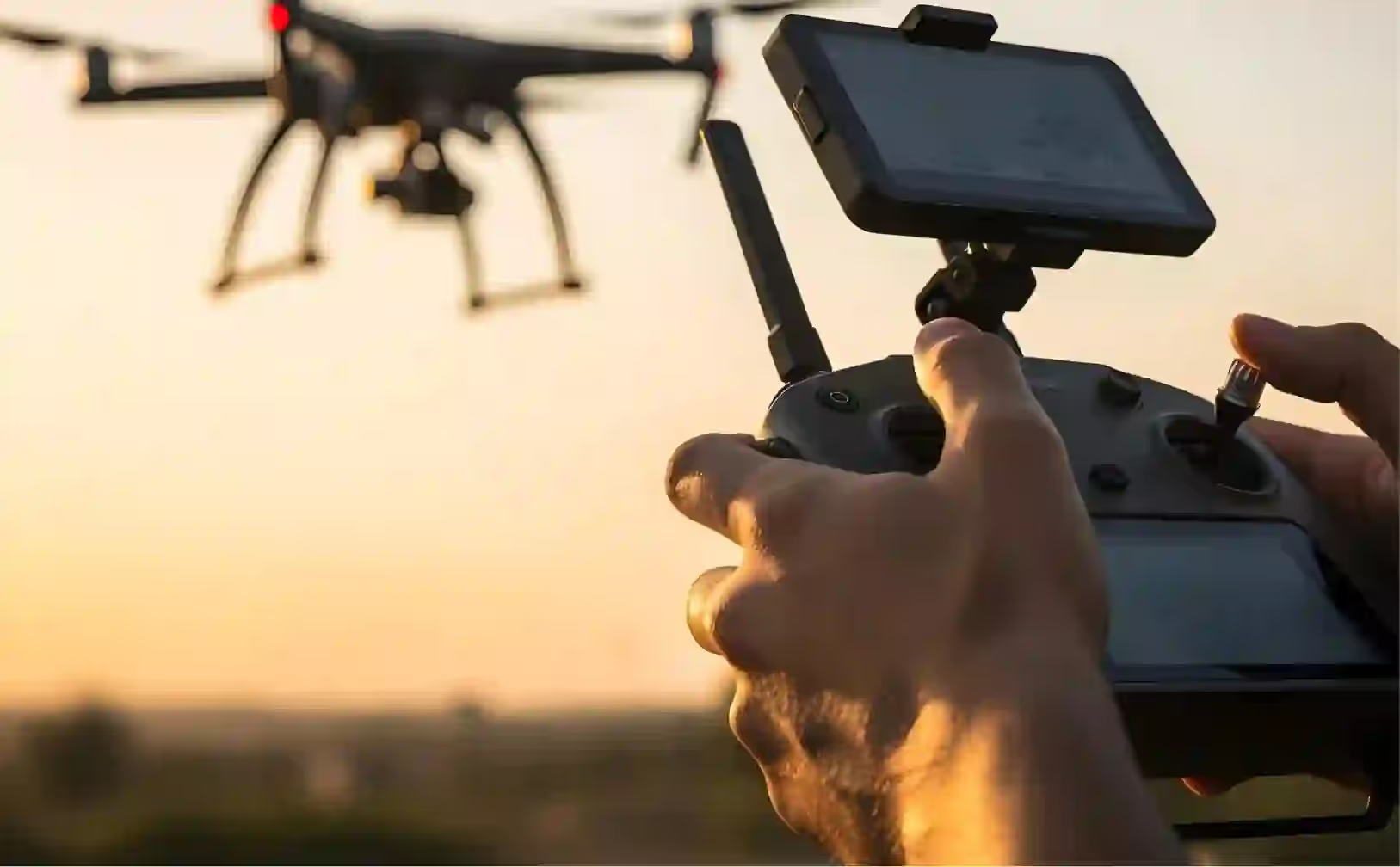
Drones face unique UAE import and operational requirements beyond standard customs clearance. The UAE has developed one of the region's most comprehensive drone regulatory frameworks—which creates both hurdles and opportunities for American exporters.
Registration and Authorization Requirements
The General Civil Aviation Authority (GCAA) serves as the primary regulator for unmanned aircraft systems in the UAE. The GCAA drone registration portal handles registration for drones operating in UAE airspace, while the national drone portal provides comprehensive regulatory guidance.
Before any drone can legally fly in the UAE, it must be registered. The registration process requires providing drone specifications, owner identification, and intended use information. For commercial operations, additional certifications and authorizations apply.
This matters for exporters because your UAE customers need to understand these requirements before importing. A drone that can't be registered can't legally operate—making it a very expensive paperweight. Part of your value proposition should include helping customers navigate registration requirements, or at minimum, ensuring the drones you export are registrable under UAE regulations.
Categories of Drones and Their Treatment
UAE regulations distinguish between drone categories based on weight, capabilities, and intended use.
Recreational drones face the simplest requirements, though registration is still mandatory. Operators must follow designated flying areas, altitude restrictions, and no-fly zones. Consumer drones from major manufacturers generally meet these requirements without difficulty.
Commercial drones used for photography, surveying, inspection, or other business purposes face additional operator certification requirements. The drone itself must be approved for commercial use, and operators need appropriate licenses.
Industrial drones with advanced capabilities—extended range, heavy payloads, sophisticated imaging systems—face the most scrutiny. These systems may require additional security approvals, especially if intended for use near critical infrastructure or in sensitive areas.
Drones equipped with certain imaging capabilities raise particular concerns. Systems with night-vision, thermal imaging, or surveillance-grade cameras may require additional authorization from security authorities beyond standard aviation registration.
Common Import Hurdles
Several issues commonly delay or complicate drone imports into the UAE.
Security concerns drive much of the regulatory framework. The UAE maintains extensive no-fly zones around airports, government facilities, and other sensitive areas. Drones perceived as potential security threats—due to payload capacity, range, or imaging capabilities—face enhanced scrutiny.
Camera and imaging restrictions catch some exporters by surprise. Drones with cameras aren't automatically prohibited, but certain camera specifications or configurations may trigger additional requirements. Privacy concerns and security considerations both play into these regulations.
Incomplete documentation creates clearance delays. Importing a drone without the technical specifications, user manuals, and registration-relevant documentation means goods sit at customs while authorities request missing information.
Lack of registration planning causes operational failures. Customers who import drones without understanding registration requirements discover they can't legally fly what they've purchased. This creates customer relationship problems that fall back on the exporter.
Drone Import Checklist for UAE
Before shipping any drone system to the UAE, verify the following:
3D printers face different import considerations than drones—less regulatory complexity on the UAE side, but potential complications where U.S. export controls and UAE end-use concerns intersect.
When 3D Printers Are Just Industrial Equipment
Most 3D printers enter the UAE as standard industrial machinery. Desktop printers, polymer-based systems, and general-purpose industrial printers clear customs without unusual difficulty. You pay applicable duties (typically 5%), provide standard commercial documentation, and the goods enter.
Duty and VAT considerations become more significant for high-value machinery. The UAE's 5% VAT applies to most imports, adding to your customer's landed cost. Free zone structures can defer or eliminate duties for goods remaining within free zones or re-exporting, but goods entering mainland UAE for use pay full duty and VAT.
When Additional Scrutiny Applies
More sophisticated additive manufacturing systems—particularly metal printers capable of producing aerospace or defense components—may attract additional attention. This isn't because the UAE specifically restricts 3D printer imports, but because end-use concerns apply.
If your metal additive manufacturing system is destined for defense-related production, aerospace component manufacturing, or research applications with potential military relevance, both U.S. export licensing requirements and UAE security considerations may apply.
Honest technical documentation becomes critical. Your commercial invoice and technical specifications should accurately describe the system's capabilities—build volume, material compatibility, achievable tolerances, production rates. Understating capabilities to simplify customs clearance creates legal exposure on both the U.S. export side and the UAE import side.
Practical Guidance for 3D Printer Exports
Working with a customs broker or logistics provider experienced in high-tech machinery smooths the import process considerably. They understand documentation requirements, common clearance issues, and how to present technical equipment in ways that facilitate rather than complicate customs processing.
Ensure HS code alignment between your U.S. export documentation and your UAE import filings. When HS codes don't match between export and import paperwork, customs authorities notice—and they ask questions. The time spent reconciling mismatched classifications before shipping is far less than the time spent explaining discrepancies after goods arrive.
For high-value systems, consider pre-clearance consultation with your UAE customs broker. Describing the shipment in advance, providing technical specifications, and confirming documentation requirements prevents surprises when the container actually arrives.
The principles discussed for drones and 3D printers extend to other high-tech categories, each with its own wrinkles.
Advanced sensors sit prominently on the Commerce Control List. LIDAR systems, certain radar configurations, infrared and thermal imaging equipment, night-vision devices, and sophisticated detection systems frequently require export licensing depending on specifications.
For UAE imports, the concern is often end use. Sensors destined for commercial applications—industrial inspection, environmental monitoring, autonomous vehicle development—typically clear without difficulty assuming U.S. export requirements are satisfied. Sensors destined for security, surveillance, or defense applications face additional scrutiny from UAE authorities in addition to U.S. licensing requirements.
Document your end-use case clearly. A thermal imaging system for industrial process monitoring presents differently than the same system for border surveillance applications.
Advanced robotics may be controlled depending on design purpose and capabilities. Systems designed for certain nuclear, chemical, or manufacturing applications may require licensing. General-purpose industrial robots typically don't trigger controls, but specialized configurations might.
The UAE's industrial modernization initiatives create strong demand for automation equipment. Satisfying that demand requires understanding where your specific robotic systems fall on the control spectrum.
Encryption capabilities trigger their own control considerations under Category 5 of the Commerce Control List. While many commercial encryption products qualify for license exceptions, certain capabilities and configurations require licensing.
UAE import requirements for communications equipment may include type approval or registration with telecommunications authorities depending on the product category.
Across all equipment categories, watch for transaction characteristics that signal elevated compliance risk.
Military or defense-adjacent end users require enhanced due diligence. Verify that any defense ministry, military contractor, or related entity isn't subject to specific restrictions.
Research applications in sensitive areas—ballistic systems, nuclear technology, advanced surveillance—warrant careful end-use analysis even when the immediate customer appears legitimate.
Requests for unusual configurations, modifications, or "no paperwork" shipments indicate customers may be attempting to circumvent controls. Walk away from transactions that don't pass basic scrutiny.
Pressure to alter documentation values, misrepresent product capabilities, or ship through unusual routing should trigger immediate concern and legal consultation.
Documentation errors cause more shipment delays than outright regulatory violations. Getting paperwork right isn't glamorous, but it's essential.
Every shipment requires standard commercial documentation including commercial invoices showing complete buyer and seller information, full product descriptions, quantities, values, and shipping terms, plus packing lists detailing contents of each package including weights and dimensions, and certificates of origin where required.
For high-tech equipment, include detailed product descriptions that match your export classification analysis. Generic descriptions like "electronic equipment" invite questions; specific descriptions like "3D printing system, polymer-based, 300mm build volume, manufacturer model XYZ" provide clarity that facilitates clearance.
Your export documentation should reflect the control status of shipped items. For controlled goods, this means including the applicable ECCN, any license numbers authorizing the export, and any license exception codes being relied upon.
For EAR99 items, your documentation should indicate that status clearly. Internal compliance records should document the classification analysis supporting your EAR99 determination.
Where applicable, include end-user statements documenting the intended use and end user of controlled items. These statements create a record of your customer's representations that may become important if questions arise later.
Arabic language requirements apply to certain product categories in the UAE. Product labeling, user documentation, and safety information may need Arabic translation or bilingual presentation depending on product type.
For drones and aviation-related equipment, include technical specifications in formats useful for registration processes—GCAA registration requires specific technical information about the aircraft.
Any certifications or approvals obtained from UAE authorities should be included with shipment documentation to facilitate customs clearance.
Before releasing any high-tech shipment to the UAE, verify:
For American exporters considering sustained UAE operations rather than one-off shipments, structural decisions about where and how to establish presence significantly impact logistics and compliance.
What Free Zones Offer. UAE free zones provide attractive conditions for foreign businesses. You can establish a company with 100% foreign ownership, avoiding the local sponsor arrangements historically required for mainland companies. Setup processes are streamlined, with dedicated free zone authorities handling licensing and registration. Logistics infrastructure in major free zones is world-class, with direct port and airport access.
Customs treatment in free zones allows goods to be imported, stored, processed, and re-exported without paying UAE duties—duties only apply if and when goods enter the mainland. For companies using the UAE as a regional distribution hub, this creates significant working capital advantages.
For high-tech equipment specifically, free zones often host industry clusters with relevant expertise. Dubai Internet City, Dubai Silicon Oasis, and similar zones attract technology companies and develop ecosystems supporting their operations.
Free Zone Limitations. The free zone advantage comes with constraints. Trading directly with customers in mainland UAE from a free zone location typically requires additional arrangements—either a separate mainland company, a local distributor relationship, or other structures allowing mainland sales.
For pure export operations or sales to other free zone companies, this limitation doesn't matter. But if your UAE strategy involves selling to mainland industrial customers, government entities, or retail channels, you'll need to address the free zone-to-mainland commercial path.
Structuring Decisions for Tech Exporters. Consider your customer base and operational model when deciding between free zone and mainland presence.
If your UAE business primarily involves import, warehousing, and re-export to broader regional markets, free zone structures offer clear advantages. You stage inventory without duty obligation, ship to GCC and other regional customers from a UAE logistics hub, and enjoy operational simplicity.
If your UAE business involves substantial sales to mainland customers, you may need a hybrid approach—free zone logistics operations combined with mainland sales capabilities, whether through your own mainland entity or partner relationships.
Free zone selection matters. Different zones offer different facilities, cost structures, and regulatory environments. A tech company benefits from locating in a tech-focused zone with relevant infrastructure and talent pools. Research zone options through official UAE government channels rather than relying solely on zone marketing materials.
Getting goods to the UAE is one challenge. Managing risks throughout the process and handling problems when they arise requires additional planning.
High-tech equipment demands appropriate insurance coverage. Standard cargo insurance may not adequately cover sophisticated electronics, precision machinery, or sensitive equipment without specific declarations and endorsements.
Ensure your insurance policy covers the specific risks relevant to your products—not just loss or damage in transit, but also coverage for goods held at customs, goods in warehouse storage, and potential complications specific to your equipment type.
Document values accurately. Underinsuring to save premium costs leaves you exposed if losses occur. Overinsuring creates its own issues if claims don't match documented transaction values.
Customs authorities may inspect shipments, particularly unfamiliar equipment types or shipments from new suppliers. This is normal procedure, not necessarily an indication of problems.
Inspections typically involve verifying that goods match documentation—opening packages, comparing serial numbers, checking specifications against declarations. Having clear, accurate documentation makes these inspections routine.
When delays occur—whether due to inspection, documentation questions, or other issues—having the right contacts matters. Your customs broker should be your first call. They can interact with customs officials, provide additional documentation, and navigate local procedures far more effectively than you can from the U.S.
Despite best preparation, shipments sometimes encounter problems. Having a response plan prevents panic and delays resolution.
Know who to contact. Maintain current contact information for your customs broker, freight forwarder, UAE logistics partner, and if necessary, local legal counsel. When goods are held, response time matters—delays in making contact compound the problem.
Keep documentation accessible. Customs authorities requesting additional documentation need it quickly. Maintain electronic copies of all shipment documents where they can be retrieved and transmitted immediately, not filed in systems requiring days to access.
Communicate with your customer. UAE customers experiencing import delays need information. Keep them informed about status, expected resolution timeline, and any actions they need to take. A frustrated customer who doesn't know what's happening is worse than a frustrated customer who understands the situation.
Learning from others' errors is cheaper than making your own. These scenarios represent real compliance failures that cost real companies real money.
Misdeclaring Products to Simplify Paperwork
The mistake: Shipping a commercial drone as a "toy" or "hobby equipment" because it sounds simpler than explaining the actual product, or understating 3D printer capabilities to avoid classification questions.
Why it fails: Customs authorities on both sides have seen these tricks before. Misdeclaration violates export regulations, creates customs fraud exposure, and if discovered—which it often is—results in seizure, penalties, and potential criminal liability.
The fix: Declare products accurately. Yes, accurate classification may require more documentation or licensing effort. That effort is vastly preferable to enforcement action.
Assuming U.S. Legal = UAE Legal
The mistake: Reasoning that because a product is legal to sell domestically and can be exported from the U.S., it must be legal to import and use in the UAE.
Why it fails: Export compliance is separate from import compliance. Satisfying U.S. requirements doesn't automatically satisfy UAE requirements. Drone registration, product certifications, end-use restrictions, and other UAE requirements apply independently.
The fix: Analyze both sides of the transaction. Understand U.S. export requirements AND UAE import/operational requirements before shipping.
Ignoring Export Controls Because "We're Just a Small Company"
The mistake: Believing that export control regulations only apply to large defense contractors or that small shipment volumes fly under regulatory radar.
Why it fails: Export control regulations apply to all exporters regardless of size. Enforcement doesn't discriminate based on company revenue. A startup shipping controlled technology without licenses faces the same liability as a Fortune 500 company.
The fix: Build compliance into your operations from the start. Classify your products, understand your obligations, and follow the rules regardless of your size.
Failing to Plan for UAE Operational Requirements
The mistake: Shipping drones to UAE customers without understanding that those drones need to be registered before they can fly, leaving customers with equipment they can't legally operate.
Why it fails: Your customer relationship suffers, and potentially the goods get returned or sit unused. The sale that looked good on paper turns into a problem.
The fix: Understand downstream requirements before shipping. Help customers navigate registration, certification, or other operational requirements. Your expertise in getting products from the U.S. to functioning deployment in the UAE adds value beyond just moving boxes.
Using Inconsistent Documentation
The mistake: HS codes, product descriptions, or values that don't match between U.S. export filings and UAE import declarations.
Why it fails: Discrepancies trigger scrutiny. Customs authorities wonder which documentation is accurate, and investigation delays clearance while exposing both parties to liability for inaccurate filings.
The fix: Coordinate documentation between exporter and importer before shipping. Ensure HS codes, descriptions, and values align across all filings.
Pulling together the concepts from this article, here's a systematic approach to your first compliant high-tech shipment to the UAE.
Step 1: Map your product portfolio. Identify every product you intend to export—3D printers, drones, sensors, other equipment. Create a complete inventory of items requiring classification analysis.
Step 2: Classify each item. Determine the ECCN or EAR99 status for each product. For products potentially subject to ITAR, obtain commodity jurisdiction determinations. Document your classification analysis thoroughly.
Step 3: Screen your customers. Before committing to any transaction, screen the end user against Entity Lists, SDN lists, and other restricted party databases. Verify end-use information. Address any red flags before proceeding.
Step 4: Determine licensing requirements. For controlled items, check Commerce Country Chart requirements for UAE. Evaluate end-use restrictions. Determine whether license exceptions apply or whether an export license application is required.
Step 5: Decide your UAE structure. Will you ship to a customer directly? Establish your own free zone presence? Work through a local distributor? Make structural decisions that align with your business model and the operational realities of your products.
Step 6: Engage qualified partners. Select a customs broker with UAE high-tech experience. Engage a freight forwarder capable of handling your equipment type. If needed, retain export control counsel and UAE legal advisors.
Step 7: Prepare documentation packages. Develop standard documentation templates for your product types. Ensure commercial invoices, technical specifications, export classifications, and any required certifications are complete before shipping.
Step 8: Coordinate UAE requirements. For drones, confirm registration pathways with your customers. For other equipment, verify any certifications or approvals required. Ensure Arabic labeling or documentation needs are addressed.
Step 9: Conduct a pre-shipment audit. Before goods leave your facility, review the entire transaction. Is classification documented? Is licensing complete or exception eligibility confirmed? Are all documents prepared and consistent? Is the end-user screened?
Step 10: Ship, monitor, and document. Execute the shipment with visibility at each stage. Maintain records of all documentation, communications, and clearance activities. These records support compliance if questions arise and inform improvements for future shipments.
Step 11: Iterate and improve. Learn from each shipment. What caused delays? What documentation questions arose? What can be standardized or streamlined? Build institutional knowledge that makes subsequent exports smoother and faster.
Export controls and import regulations feel like obstacles when you first encounter them. Another layer of bureaucracy between your products and customers who want to buy them.
That perspective misses the strategic reality.
Companies that build robust compliance programs—that understand their products' control status, maintain clean end-user screening processes, develop documentation systems that work, and establish relationships with qualified logistics and customs partners—don't just avoid penalties. They operate faster, more predictably, and more scalably than competitors who treat compliance as an afterthought.
When your competitor's shipment sits at Dubai Customs while they scramble to answer questions about mismatched HS codes, your shipment clears in days because your documentation was right from the start. When their customer waits months for re-export after a failed import attempt, your customer is already operating because you helped them understand registration requirements before they ordered.
The UAE wants this technology. Their smart city initiatives, aerospace programs, industrial modernization efforts, and research clusters create genuine demand for American 3D printers, drones, sensors, and sophisticated equipment. They've built the infrastructure—ports, free zones, regulatory frameworks—to support these imports.
Your job is to meet them halfway. Understand what the U.S. government requires before products leave American soil. Understand what UAE authorities require before products enter Emirati territory. Build systems that satisfy both, document everything, and work with partners who know how to navigate the spaces between regulations and reality.
Do that consistently, and the UAE becomes not just one market but a gateway to the broader Gulf region. Products that clear into UAE free zones can move onward to Saudi Arabia, Kuwait, Qatar, and other GCC markets. A compliance infrastructure built for the UAE serves regional expansion beyond it.
The opportunity is real. The regulations are navigable. The question is whether you'll invest in doing it right.
NOVEMBER 27, 2025
NOVEMBER 26, 2025
NOVEMBER 26, 2025
NOVEMBER 26, 2025
NOVEMBER 26, 2025